Lake County recently took another tangible step toward addressing local housing supply by bringing together municipal leaders and developers for collaborative discussions intended to fuel development.

The event was sponsored by Old National Bank, and the format was fast-paced and intentional. Eleven municipalities sat down with eleven developers in a round-robin, five-minute matchmaking session. Community development staff brought forward real sites—places ready, or nearly ready, for multifamily housing. Developers, in turn, gained direct insight into where multifamily housing opportunities exist and which communities are actively seeking investment.
“At first glance, this event may seem like a straightforward networking exercise,” noted Connie Lavin, the Market President and Business Banking Director at Old National Bank and a long-time member of Lake County Partners’ Board of Governors. “In reality, it’s far more important because it reflects something much bigger: a coordinated, countywide strategy to align housing development with economic growth.”
Housing is Economic Infrastructure
Lake County has long been recognized as a strong business environment, driven by its workforce, infrastructure, and access to major markets. But increasingly, in part due to discussion that arose from the development of the community’s Comprehensive Economic Development Strategy (CEDS), leaders began teasing out the connections between housing availability and quality of life.
The CEDS calls for a more inclusive and forward-thinking approach to growth, emphasizing that long-term economic success depends on addressing challenges like attainable housing, affordability and early childhood care and education alongside traditional business development priorities such as taxes, utilities and incentives.
This shift has been significant. Historically, economic development strategies focused heavily on attracting and expanding businesses. Today, Lake County is broadening that lens—understanding that without a diverse and attainable housing supply, workforce attraction and retention become increasingly difficult.
“The recent multifamily networking event is far more than just a one-day initiative. It is a direct implementation of the CEDS vision: breaking down silos, fostering collaboration, and accelerating real, on-the-ground development opportunities,” notes Steve DeBretto, Lake County Partners’ Director of Strategic Initiatives.
Housing Lake and LCP’s work connecting municipalities with developers looking for their next project comes as housing creation gains statewide attention. Against the backdrop, Governor Pritzker’s Building Up Illinois plan proposes state-level policies on density, parking minimums, impact fees, and permitting that many municipalities say erode local control. Whatever the outcome of those legislative proposals, Lake County stakeholders are working to create housing that people across a range of incomes can afford.
From Strategy to Action: The Role of Housing Lake
If the CEDS provides the roadmap, the Housing Lake initiative is helping to drive execution. Housing Lake is a countywide coalition designed to bring together business leaders, elected officials, developers, and community advocates to create actionable strategies for increasing attainable housing. Its mission is clear: align stakeholders, identify barriers, and move projects forward in a way that reflects the character and needs of Lake County communities.
Recent actions through the Housing Lake initiative reflect a shift from planning to implementation, driven by an unprecedented level of cross-sector collaboration. Over a seven-month process, more than 175 leaders—including municipalities, developers, employers, and nonprofit organizations—worked together through structured workshops and data analysis to identify barriers and opportunities for housing growth across the county.
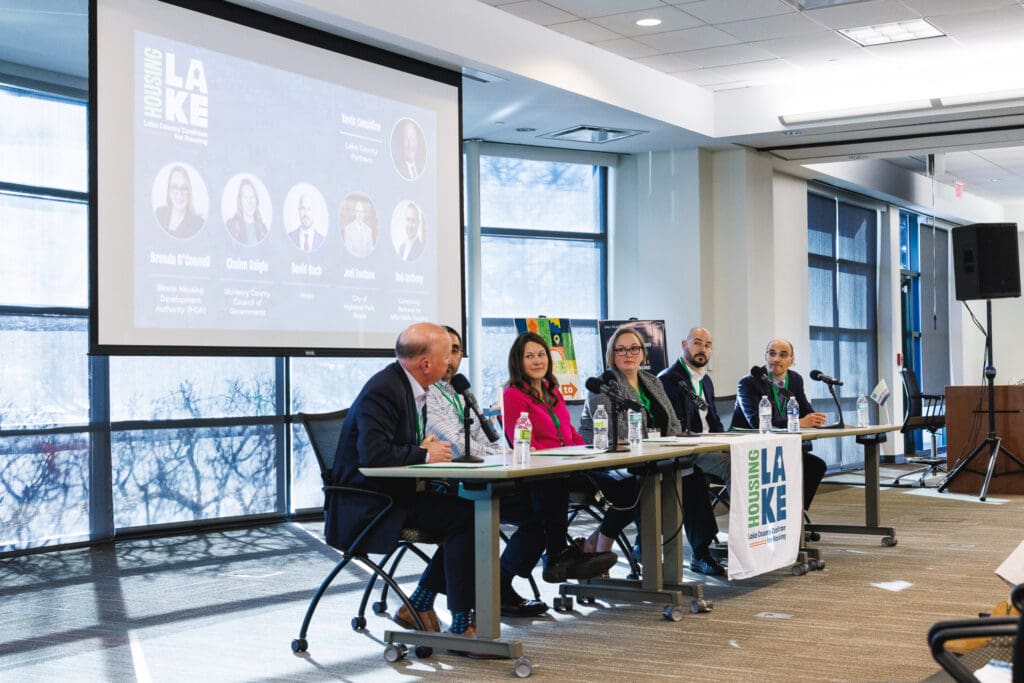
This effort culminated in a countywide “Call to Action,” which is a roadmap focused on expanding housing options for workers, seniors, and young professionals while addressing a shortage of more than 18,000 homes.
“We are focused on actionable housing solutions such as aligning local policies, improving development pipelines, and fostering public-private partnerships. We want to ensure that housing is treated not just as a community issue, but as a central pillar of Lake County’s long-term economic competitiveness,” notes Dominic Strezo, Lake County’s Community Development Administrator.
The recent multifamily networking event is an extension of the work that began with the CEDS and carried on with the Housing Lake initiative.
“One of the biggest challenges in housing development is fragmentation—municipalities may have sites but lack developer relationships, while developers may be searching for opportunities but lack visibility into local priorities,” noted DeBretto. “By putting both sides in the same room, the event removed friction from the process.”
It also did something equally important: it signaled intent.
Municipal participation demonstrated that communities across Lake County are not just open to multifamily housing—they are actively pursuing it. For developers, that clarity reduces uncertainty and helps de-risk potential projects.
Building a Pipeline, Not Just Projects
What makes this approach particularly effective is its focus on pipeline development rather than one-off deals.
“We are hopeful that our conversations will spark a future project, and create new opportunities for us to explore,” said Allison Matson, the Village Administrator at the Village of Wauconda. “We appreciated the efficiency of the networking, and the fact that we were all there to move multifamily development forward in a way that aligns with our region’s goals and high quality of life.”
“This was an incredible opportunity to meet so many Lake County municipal leaders and staff,” said Nick Anderson, President of Fern Hill Company. “Importantly, we also learned a great deal about each municipality’s housing goals and how the development community can work cooperatively with our public sector colleagues to put housing into production on immediately actionable sites while supporting long-range community planning goals.”
Over time, this kind of engagement builds momentum. It creates a steady flow of conversations, proposals, and, ultimately, construction activity.
That pipeline is critical. Housing shortages are not solved by a single development; they require sustained, coordinated effort over years. By institutionalizing collaboration through events like this, Lake County is laying the groundwork for long-term success.
Aligning Growth with Community Character
Of course, increasing housing supply is not just about quantity—it’s about fit.

One of the strengths of the speed networking model is that it allows municipalities to present sites within the context of their community vision. Rather than reacting to unsolicited proposals, local leaders can proactively guide development toward locations and formats that align with their goals.
This approach reflects another key principle embedded in both the CEDS and Housing Lake: growth should be thoughtful and inclusive.
Lake County’s strategy acknowledges that different communities have different needs. Some may prioritize transit-oriented development, while others focus on workforce housing near employment centers. By fostering direct dialogue between municipalities and developers, the county is enabling more tailored, context-sensitive solutions.
A Competitive Advantage for Business Growth
The implications of this work extend far beyond housing.
For companies considering expansion or relocation, housing availability is increasingly a deciding factor. A strong housing pipeline supports talent attraction, reduces commute burdens, enhances overall quality of life, and ultimately contribute to a region’s competitiveness.
Lake County Partners has long emphasized the importance of a holistic business environment, connecting companies with workforce, infrastructure, and community resources. Efforts that promote housing accessibility expand that value proposition by ensuring that development keeps pace with economic growth.
In other words, housing is no longer a secondary consideration—it is a central component of Lake County’s business strategy.
Collaboration as a Catalyst
Perhaps the most important takeaway from the event is the power of collaboration and coordinated strategy, and this is a cornerstone for which Lake County is known.
The CEDS was built through extensive engagement with business, education, and civic leaders across the region, emphasizing alignment as a key driver of success. Housing Lake has continued that tradition by bringing diverse stakeholders together around a shared goal.

The speed networking event is a natural extension of this philosophy. It demonstrates that when the right people are in the room—and when conversations are structured with purpose—progress can happen quickly.
Looking Ahead: Prioritizing Housing
As Lake County continues to prioritize housing within its economic development strategy, similar initiatives will play a key role in maintaining momentum.
The challenge now is to build on this foundation by tracking outcomes, supporting projects as they move through the development pipeline, and continuing to identify new opportunities for collaboration.
If successful, the impact will be far-reaching.
More multifamily housing will mean greater accessibility for workers at all income levels. Communities will be better positioned to grow sustainably. Businesses will benefit from a deeper, more stable talent pool.
And perhaps most importantly, Lake County will continue to demonstrate that economic development is not just about growth. It’s about creating a place where that growth is shared, supported, and sustainable.