In the world of economic development, the “old way” of doing business was often a zero-sum game—counties competing against their neighbors for the same slice of the pie. But as the Greater Chicagoland Economic Partnership (GCEP) 2025 Year in Review makes clear, Chicagoland has pivoted and is playing a much bigger game.

“If we could call the first year of GCEP an exploration of structured regionalism in the Chicagoland area, and the second year an expansion of it, then 2025 can only be characterized as a year of maturation and acceleration,” notes Doug Pryor, the Vice Chair of GCEP and the president and CEO of the Will County Center for Economic Development. “Building upon the momentum and collaborative frameworks established in previous years, 2025 reinforced our commitment to elevating Chicagoland as a unified economic force on the global stage. This year marked several significant milestones that demonstrate the strength of our regional partnership.”
By uniting the City of Chicago and the seven surrounding counties (Cook, DuPage, Kane, Kendall, Lake, McHenry, and Will), GCEP has elevated the Chicago metropolitan region’s status as a global economic powerhouse. The results extend beyond data into groundbreakings, ribbon cuttings, international delegations, thousands of new jobs across the community and a historic winning streak that has made Chicagoland the #1 U.S. metro for corporate relocations and expansions for the 13th consecutive year.
In Lake County, 2025 wasn’t just a good year; it was the county’s best year on record for economic growth—a contributing factor in Lake County’s designation as one of the top 10 counties in the U.S. for economic development. This isn’t a regional participation trophy; it is a ranking against over 3,000 counties nationwide.
As a proud partner in this regional alliance, Lake County has leveraged the collective strength of Chicagoland to secure high-value investments that solidify its status as a global hub for life sciences, advanced manufacturing, and corporate innovation.
The Power of Partnership: Chicagoland’s Value Proposition
The most significant headline of 2025 is Chicagoland’s retention of its crown as the #1 U.S. metro for corporate relocations and expansions for the 13th consecutive year. This ranking, awarded by Site Selection Magazine, is a testament to the region’s enduring stability.
In 2025, World Business Chicago (WBC) tracked a record 223 “Pro-Chicagoland Decisions” (PCDs)—representing a massive 40% year-over-year increase in companies choosing to move to or grow within the region. These decisions accounted for:
- 19,600 new and retained jobs
- $1.7 billion in estimated annual earnings
- 26 million square feet of commercial and industrial space
One of Chicagoland’s greatest structural advantages is its lack of reliance on a single industry. No single sector accounts for more than 13% of the regional GDP, a level of diversity that provides a natural hedge against market volatility.
The 2025 project breakdown illustrates this strength:
- Manufacturing (38% of projects): Remains the bedrock of the region, fueled by reshoring trends and advanced production.
- Professional, Scientific & Technical Services (16%): Reflects a thriving ecosystem for engineering and high-tech innovation.
- Transportation & Warehousing (13%): Anchored by the nation’s premier multimodal logistics network.
While established industries remain strong, Chicagoland is rapidly becoming a magnet for “Growth Capital.” In 2025, regional companies raised a total of $6.0 billion in growth capital—a significant jump from the previous year.
Investors are increasingly betting on Chicagoland’s strengths in:
- SaaS and AI/Machine Learning
- Climate Tech and CleanTech
- HealthTech and Life Sciences
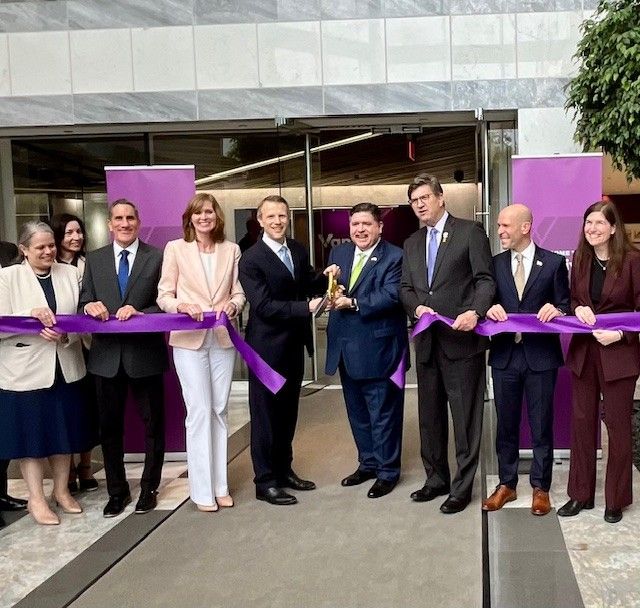
High-profile wins like the groundbreaking of the Illinois Quantum and Microelectronics Park and major expansions by companies like Abbott Labs and Vantive highlight the region’s growing dominance in next-generation technology.
GCEP’s 2025 report also confirms that Chicagoland is the undisputed logistical heart of North America. O’Hare International Airport was named the #1 U.S. port by trade value, handling a staggering $423 billion in trade—a 28% increase from 2024.
This global connectivity is supported by the CenterPoint Intermodal Center, the largest inland port in the nation, making Chicagoland the most efficient place to move goods across the continent.
At the core of every “Pro-Chicagoland Decision” is the search for talent. The region boasts a labor force of nearly 5 million people, larger than the workforces of 41 U.S. states. Even better, local talent is self-renewing:
- 150,000+ graduates annually from world-class universities
- 3.2 million residents with an associate’s degree or higher
- A top-10 national ranking for Computer and Mathematical occupations
GCEP was founded on a simple premise: the region is stronger together. By pooling resources and coordinating the pitch to global site selectors, the partnership has elevated the entire region’s profile. In 2025, this strategy paid off as it streamlined the front door for businesses looking to enter the Illinois market.
Whether a company needs the urban density of the Loop or the cutting-edge pharmaceutical campuses of Lake County, GCEP ensures that business leaders find a home within the region instead of in a competitor state.
What Does This Mean for Lake County?
While the regional success is impressive, Lake County’s individual performance within the partnership has been nothing short of historic. The fiscal impact of this success in 2025 alone is staggering:
- $633 Million in new capital investment
- 1,862 New Jobs
- 1,333 Jobs Retained
The success of GCEP and Lake County Partners is best seen through the lens of the iconic brands choosing to grow here. These aren’t just business transactions; they are votes of confidence in our workforce and our future.
1. Global Headquarters Consolidation: Fortune Brands Innovations
One of the biggest wins of 2025 was the consolidation of Fortune Brands Innovations into a single global headquarters in Deerfield. After a competitive nationwide search, the company chose Lake County for its 358,000 sq. ft. Class A office campus. Why? Because, according to the company, of Lake County’s “exceptional workforce and culture of innovation.” They are currently two years ahead of their hiring goals, with capacity for over 1,000 associates.
2. The Life Sciences Powerhouse: AbbVie, Plano Pharmaceuticals & Endotronix

Lake County continues to dominate the life sciences sector. AbbVie reinforced its deep roots in North Chicago with a $192 million capital investment to expand manufacturing capacity. Meanwhile, Plano Pharmaceuticals selected Lake County for its new headquarters, as a biopharma powerhouse. In nearby Dupage County, medical device company Endotronix expanded beyond a healthcare startup incubator, was acquired by Edwards Lifesciences and received FDA approval of its flagship product, the Cordella PA Sensor, which manages heart failure.
3. Advanced Manufacturing: Flex, Freedman Seating and AFA Dispensing
Advanced manufacturing remains the backbone of our local economy. Flex announced a major investment in Libertyville, creating new jobs and building upon Flex’s existing presence in Buffalo Grove—proving that when companies land in Lake County, they stay and grow. In Chicago, Freedman Seating secured new investment to modernize its manufacturing operations, retain nearly 700 jobs, and create additional positions—reinforcing its long-standing role as a leader in transportation seating manufacturing.
Similarly, AFA Dispensing in McHenry County experienced significant growth through facility expansion and increased production capacity, positioning the company to meet rising global demand while adding new jobs and strengthening the region’s advanced manufacturing ecosystem. Together, these wins underscore how coordinated regional efforts are successfully supporting legacy manufacturers and high-growth companies alike—driving job creation, capital investment, and long-term economic competitiveness across Chicagoland.
4. Transportation, Distribution & Logistics: RJW Logistics
Chicagoland has long held a top position as one of North America’s premier transportation, distribution, and logistics hubs—anchored by its unmatched multimodal infrastructure, central location, and access to national and global markets. This strength continues to attract major supply chain and e-commerce players seeking speed, efficiency, and connectivity. A standout example is RJW Logistics Group in Kendall County, which expanded its regional footprint with new, large-scale warehouse capacity and job creation to support growing demand from national retail and e-commerce clients.
5. Food Preparation: The Fresh Factor & Savor
Chicagoland continues to stand out as a powerhouse in food preparation and production, supported by its central location, robust supply chain, and access to top-tier talent. The region saw notable growth from companies like The Fresh Factory in Will County, which expanded its operations to scale production of plant-based and better-for-you foods will keeping its existing jobs and adding an additional 100.
At Savor in Kendall County, the company advanced biotechnology backed by Bill Gates’ Breakthrough Energy Ventures to dramatically reduce the environmental footprint of food production and create animal-free butter and other fats without agriculture.
Together, these projects highlight how Chicagoland is fostering innovation in food manufacturing while creating jobs and strengthening one of its most dynamic industry clusters.
Beyond the Office: Building a Place for People
Economic development is about more than just square footage and tax revenue; it’s about quality of life. The 2025 GCEP report highlights a regional shift toward “holistic growth,” ensuring that as communities attract businesses, they also build the infrastructure to support their employees.
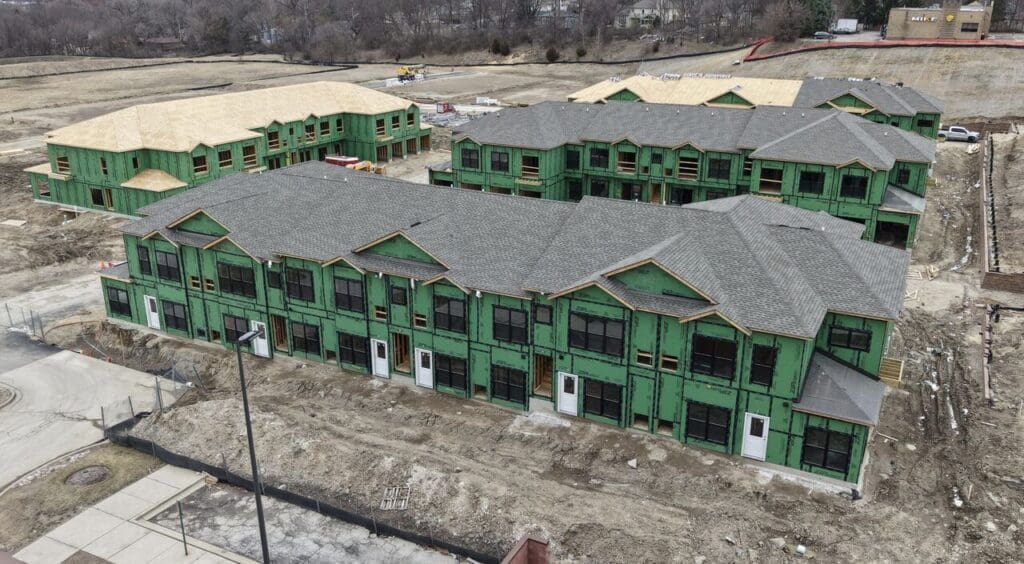
In Lake County, this has manifested in a major push for “missing middle” housing. A standout project is “The Quarry” in Fox Lake, a $41 million investment delivering townhome-style apartments. By creating vibrant, walkable communities, Lake County can ensure that the talent being recruited by companies like AbbVie and Fortune Brands has a place to happily call home.
Economic development is about more than just square footage and tax revenue; it’s about quality of life. The 2025 GCEP report highlights a regional shift toward “holistic growth,” ensuring that as communities attract businesses, they also build the infrastructure to support their employees. In Lake County, this has manifested in a major push for “missing middle” housing. A standout project is “The Quarry” in Fox Lake, a $41 million investment delivering townhome-style apartments. By creating vibrant, walkable communities, Lake County can ensure that the talent being recruited by companies like AbbVie and Fortune Brands has a place to happily call home.
Why the GCEP Model Works for Lake County
You might wonder: If Lake County is so successful on its own, why does it need GCEP?
The answer lies in the complexity of the modern global economy. When a major international firm considers a move, they don’t look at county lines; they look at the talent pool, the airport access, and the supply chain. By working with GCEP, Lake County Partners can:
- Broaden the Talent Pipeline: Business can draw from a regional workforce of millions, supported by a “cradle-to-career” educational system that includes the College of Lake County, Rosalind Franklin University and world-class universities in Chicago.
- Leverage Infrastructure: Businesses benefit from O’Hare’s global reach and the local rail network, assets that are marketed more effectively as a unified region.
- Share Intelligence: Regional data sharing allows partners to identify emerging industry trends—like the rise of quantum computing or green energy—long before competitors do.
- Be a Part of Regional Strategy: GCEP is a vehicle for collaboration, and Lake County’s participation puts local leaders at the forefront of business attraction and retention strategies, ensuring that perspectives from Chicago’s northern suburbs are equally represented.
Looking Ahead: The Future is Regional
GCEP’s 2025 Year in Review is both a victory lap and a roadmap. The challenges of the future—from digital equity to sustainable energy—are too large for any one municipality to tackle alone.
Looking toward 2026, Lake County remains committed to the Greater Chicagoland Economic Partnership. Regional collaboration doesn’t dilute local identities; it amplifies them. Another record-breaking year is proof that when we stop competing with neighbors and start competing with the world, everyone wins.